






Sclerotherapy include some of the treatments used in treating varicose and spider veins. It involves the use of a solution that pulls the veins and causes them to shrink and incorporate themselves out of the area affected. This results to the gradual elimination of the affected veins from the body over time Their action creates this effect hence the disappearance of the veins over treated period.
History and Development
Sclerotherapy was first used in the 19th century. The earlier methods included the application of one or another irritant solution; the present-day methods ensure relatively greater effectiveness, although the application of an irritant solution does not necessarily pose a significant risk.
Over the years, improvement in the imaging system like ultrasound has made sclerotherapy more efficient in removing deep veins.
Syringes and Needles
30 Gauze needle
Sclerosing Agents: Hypertonic saline, sodium tetradecyl sulfate (STS), and polidocanol.
Vein Light or Transilluminator
Compression Stockings/Bandages
Ultrasound Machine
Alcohol Swabs and Sterile Pads
Sterile Gloves
Local anesthetics
Consultation:
Always check with your doctor to discuss your past medical history, especially the details of any allergies, the current medications that you are using, and the previous attempts made at treating the varicose veins.
Discuss your expectations and the likely issues that you would want to be addressed concerning the procedure.
Medication Review:
It is important to disclose all your medications like counters, supplement, and herbals to your healthcare provider.
Comfortable Clothing:
It is suggested that the patients should wear comfortable loose dress before going to the appointment. At some point, depending on the procedure that is being conducted on you, you will be required to wear a gown.
Pre-Procedure Instructions:
Comply with any other additional techniques that the physician may have suggested. This may involve failure to take a meal or giving some types of medications to the patients.
Post-Procedure Care:
After the procedure, the directions provided by the healthcare provider is essential such as usage of compression stockings, certain activities that one should not indulge in and ensuring the cleanliness of the treated area.
The preferred position is supine.
Special attention should be paid to comfort, and the patient’s position should be correct both for access to the treatment area. Certain changes are based on the vein type that is being treated, or perhaps the surgeon’s decision.
Step 1-Patient Evaluation: The physician meets the patient, determines their case, examines veins physically and employ ultrasound to assess veins’ location.
Pre-procedure Instructions: The patient should avoid using aspirin or ibuprofen before the appointment. The medical instructions which should be followed can be associated with non-smoking and avoiding application of lotion on the leg.
Step 2-Positioning: The patient must lie on an examination table with their legs slightly raised.
Step 3-Cleansing: Preparing the treatment area, the area to be treated is washed with an antiseptic solution.
Injection:
Step 4-Needle Insertion: Sclerosant solution is then applied to the vein by inserting a thin needle.
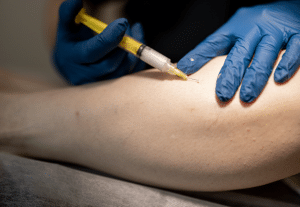
Sclerotherapy
Sclerosant Solutions: The usually used solutions are hypertonic saline, sodium tetradecyl sulfate, polidocanol, and glycerin.
Injection Technique: The choice of sclerosant depends on the type and location of the vein; the physician guides the sclerosant to the target site using direct visualization, transillumination, or ultrasound.
Step 5-Compression: After twenty-four hours of the injection, a pressure is applied on the injected area using cotton balls or pads and secured with a tap.
Multiple Injections: Several veins can be done at a time, and several injections are administrated along the length of the vein.
Step 6-Post-Procedure Care:
Compression Stockings: The standard prescription to patients is to wear the stockings for several days to at most two weeks to help in the reduction of swelling and treatment of the affected part.
Activity: To avoid blood clots, patients are advised to exercise rather than spend much time sitting or standing. For a few days, one should refrain from hard lifting and strenuous activity.
Follow-Up: The patient is usually advised to return for a check-up to assess if they require more treatment.
Blood Tests:
Coagulation Profile: Coagulation profile may include Prothrombin time and Partial thromboplastin time which helps to determine extent of blood coagulation capacity.
Complete Blood Count (CBC): To ensure that there is no clinically relevant pathology that might complicate the carrying out of the procedure for instance anemia or infection.
Liver Function Tests: As some sclerosing agents are metabolised in the liver, liver function test may be required before the procedure.
Bruising: Redness and swelling at the site of administration may occur, and there may be developing of bruises that are usually shed after a few weeks.
Redness and Swelling: These are mainly local side effects that manifest at the injection site and are mostly transient.
Blood Clots: In rare cases, blood clots can form in the treated veins, which may require drainage.
Inflammation: This may cause pain and formation of a lump at the treated area and if this is the case, it is advised to use anti-inflammatory medication.
Hyperpigmentation: Sometimes, it may develop a line that is brown or small spots that surround the vein that was treated. These are typically only temporary, but duration of the discoloration may be permanently in specific cases.
LEARNING & CME
View All
Advanced
Cardiovascular
Life Support
Basic Life
Support
Pediatric
Advanced Life
Support

Neonatal
Resuscitation
Program

Annual Stroke
Center
Continuing
Education

Opioid and Pain
Management

National
Institutes of
Health Stroke
Scale

Basics of
Electrocardiography