






A non-invasive medical device called pulse oximetry is used to evaluate a person’s blood’s oxygen saturation. It provides a valuable indicator of how well oxygen is being transported to the body’s extremities, including the fingers and toes. The device used for pulse oximetry is called a pulse oximeter.
Principle of Operation:
- Pulse oximeters work on the principle that oxygenated and deoxygenated hemoglobin (the proteins in red blood cells responsible for carrying oxygen) absorb light differently.
- The device typically emits two wavelengths of light, usually red and infrared, through a translucent part of the body, often a fingertip.
- The blood’s oxygen saturation is then determined by measuring how much light is absorbed by oxygenated and deoxygenated haemoglobin.
Development and History:
- The development of pulse oximetry dates back to the early 1970s. The first commercial pulse oximeter was introduced in 1981.
The technology has since evolved, becoming more compact, accurate, and affordable. It is now widely used in various healthcare settings, including hospitals, clinics, and even for home monitoring.
Pulse Oximeter:
- Choose a reliable pulse oximeter with appropriate sensors for the patient population (e.g., pediatric or adult).
- Ensure that the pulse oximeter is functioning correctly and the batteries are charged or replaced as needed.
Sensor Placement:
- Select an appropriate site for sensor placement. The most common locations are the fingertip, earlobe, or toe.
- Ensure that the sensor site is clean, dry, and free from excessive hair or jewelry that might interfere with proper contact.
Secure Sensor:
- Properly secure the pulse oximeter sensor to the chosen site. Ensure that it is snug but not too tight, allowing for proper blood flow to the area.
Calibration:
- Some pulse oximeters may require calibration or verification of accuracy before use. Follow the manufacturer’s guidelines for calibration if necessary.
- Comfortable Position: Ensure the patient is in a comfortable position for the procedure. This might include lying on a procedure table, sitting in a chair, or assuming a specific position, depending on the nature of the procedure.
- Accessibility of Monitoring Site: Choose a monitoring site that is easily accessible and does not interfere with the procedure. For example, if the procedure involves the upper extremities, placing the pulse oximeter on a finger may be appropriate.
- Secure Wiring: Make sure that the patient’s pulse oximeter wire is securely fastened without being too tight to the point of discomfort or impeding mobility.
- Consider Special Populations: For pediatric patients or patients with specific conditions, choose the appropriate sensor size and location based on the patient’s age, size, and medical condition.
- Patient Education: Communicate with the patient about the purpose of the pulse oximeter, emphasizing that it is a non-invasive and painless monitoring tool. Address the patient’s concerns and queries.
During the Procedure:
- Continuous Monitoring: Activate continuous monitoring and ensure that the pulse oximeter is displaying real-time oxygen saturation readings.
- Prompt Action for Changes: Be attentive to any significant changes in oxygen saturation levels and respond promptly. Address potential issues such as changes in patient positioning or sensor dislodgment.
- Documentation: Document baseline oxygen saturation levels before the procedure and monitor trends throughout. Document any interventions taken in response to changes in oxygen saturation.
- Integrate with Anesthesia Monitoring (if applicable): If the procedure involves anesthesia, integrate pulse oximetry monitoring with other anesthesia monitoring devices for a comprehensive assessment of the patient’s vital signs.
Digit Approach:
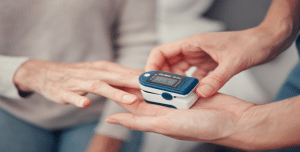
- The recommended technique involves the placement of a transmission probe at the end of a digit, typically the finger, where the emitter is positioned on one side and the sensor on the opposite side. To ensure accurate readings:
- The digit should be positioned in a comfortable and shaded manner to prevent excessive light interference.
- Prior to probe attachment, it is crucial to eliminate any excessive debris, nail polish, or artificial nails that might impede proper contact.
- Connect the probe securely to the monitoring unit to initiate the pulse oximetry process.
Ear Approach:
- A transmission probe is applied to the end of an earlobe, with the emitter and sensor on opposite sides.
- Subsequently, connect the probe to the monitoring unit to initiate the pulse oximetry measurements.
Palm/Foot Approach in Neonates:
- In cases where neonates pose challenges for digit or ear placement:
- Apply a transmission probe over the palm or foot, considering their size.
- Connect the probe to the monitoring unit to commence pulse oximetry for neonatal patients.
Forehead Approach:
For readings from the forehead:
- Place a reflectance probe just above the eyebrows on the forehead, ensuring it is positioned away from significant vessels.
- The patient should be comfortably inclined during the process.
- Secure the probe with a headband placed across the forehead.
- Connect the probe to the monitoring unit for continuous pulse oximetry monitoring.
- Motion Artifacts: Excessive patient movement or motion can lead to inaccuracies in pulse oximetry readings. This is especially relevant in situations where patients are agitated, restless, or involved in physical activities.
- Poor Peripheral Perfusion: Conditions that result in poor peripheral perfusion, such as hypotension or shock, may affect the accuracy of pulse oximetry readings. In such cases, central venous oxygen saturation (ScvO2) monitoring or arterial blood gas analysis may be more reliable.
- False Readings in Certain Conditions: Certain medical conditions, such as anemia, carbon monoxide poisoning, or methemoglobinemia, can potentially result in inaccurate pulse oximetry readings. These conditions affect the oxygen-carrying capacity of hemoglobin.
- Nail Polish and Artificial Nails: Dark-colored nail polish or artificial nails can absorb light and interfere with the transmission of light through the finger, potentially leading to inaccurate readings.
- Skin Conditions: Skin conditions affecting the area where the pulse oximeter is applied, such as burns, tattoos, or scars, may interfere with proper sensor contact and accurate readings.
- Inaccuracies in Presence of Intravenous Dyes: Certain intravenous dyes used in medical procedures, such as indocyanine green or methylene blue, may interfere with the accuracy of pulse oximetry readings.
- Delay in Detecting Rapid Changes: Pulse oximetry may not detect rapid changes in oxygen saturation, and there may be a delay in reflecting sudden drops in oxygen levels.
False Readings during Movement: Patient movement during the application of pulse oximetry, especially in critical care or during procedures, can result in false readings. This can lead to unnecessary interventions or delays in addressing actual changes in oxygenation.
LEARNING & CME
View All
Advanced
Cardiovascular
Life Support

Basic Life
Support

Pediatric
Advanced Life
Support

Neonatal
Resuscitation
Program

Annual Stroke
Center
Continuing
Education

Opioid and Pain
Management

National
Institutes of
Health Stroke
Scale

Basics of
Electrocardiography