






The Nd YAG (Neodymium-doped Yttrium Aluminum Garnet) laser is a versatile and widely used solid-state laser.
Nd laser was first demonstrated by J.E. Geusic in 1964. Neodymium (Nd) selected for laser ion due to strong energy transitions for high-power lasers.
YAG crystal’s superior thermal properties ideal for continuous and pulsed laser operations.
A crystal of YAG doped with neodymium ions. The doping concentration ranges from 0.5% to 1.4%.
Nd³⁺ ions energized with flash lamps or laser diodes in an optical resonator with two mirrors amplify light through stimulated emission.
Laser beams used for cutting and welding can be pulsed for high peak power in bursts. YAG crystals enable continuous operation.
Equipment required:
Nd Laser System
Q-switched Nd and Long-pulsed Nd
Laser Delivery System
Laser Safety Goggles
Patient Preparation:
Both patient and clinician must wear laser safety goggles during skin and dental procedures.
Adjust laser settings based on procedure and patient factors. Use lower settings on dark skin to prevent burns and hyperpigmentation.
Cooling devices used before and after laser pulses for comfort. Minimize discomfort and protect skin with cooling before/after laser.
Patient Positioning:
Ensure patient comfort during procedures. For ophthalmology, position with chin on slit-lamp rest.
For dermatology, patient can be lying or seated depending on treatment area.
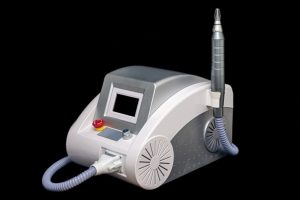
Nd YAG laser device
The laser should be set from 1 to 3 mJ with Q-switched and mode locked.
Q-switched laser produces 12-20 nanosecond single pulses series while a mode-locked laser produces 25-30 picoseconds.
Helium-neon laser is used to focus Nd YAG laser slightly behind lens to prevent damage.
Silicone lenses prone to damage, while polymethylmethacrylate lenses are the most durable choice.
Laser treatment methods vary by surgeon and opacity density. A cross-pattern starting from periphery is recommended by physicians to reduce risk.
Some physicians suggest avoiding circular lasers in favour of firing on stress lines.
Create a 3-mm inverted U-shape capsule to reduce postoperative floaters which keep the flap away from the visual axis.
Various methods for treating lens tilt and Z syndrome with Nd YAG laser involve creating a small oval capsulotomy between the hinge and insertion of hinge loops to relieve tension.
Complications:
Increased Intraocular Pressure (IOP): A sudden rise in IOP may occur immediately after the procedure due to the release of lens capsule debris into the aqueous humor.
Retinal Detachment: A rare but serious complication caused by the shockwaves generated by the laser.
Damage to Intraocular Lens (IOL): Inaccurate laser targeting can cause pits or cracks in the IOL.
Incomplete Iridotomy: It may require re-treatment if the opening in the iris is not sufficient to relieve IOP.
Inflammation/Uveitis: Inflammation of the iris or ciliary body, usually mild and self-limiting with NSAID eye drops.
Hyperpigmentation or Hypopigmentation
Skin Burns or Blistering
Gingival Burns
Delayed Healing or Infection
Poor oral hygiene post-treatment
Bleeding or Hematoma
Airway Burns
Eye Injury
Swelling or Redness
LEARNING & CME
View All
Advanced
Cardiovascular
Life Support
Basic Life
Support
Pediatric
Advanced Life
Support

Neonatal
Resuscitation
Program

Annual Stroke
Center
Continuing
Education

Opioid and Pain
Management

National
Institutes of
Health Stroke
Scale

Basics of
Electrocardiography