






A complete maxillary nerve block is not necessary because large area of anesthesia which is provided by maxillary nerve block are maxillary teeth, nearby soft tissues, zygomatic, dural, and temporal regions and maxillary sinus mucosa. All of these parts are insufficient for most procedures. Only a small area like a single tooth or targeted nerve is needed to be anesthetized. This also minimizes discomfort of the patient.
Material which are needed to perform MNB:
Cotton swab
Retractors
Sterile drapes
22-gauge needle
5mL and 2mL syringes
32-36mm of 25-gauge long needle
Mouth props
Local anesthesia up to 2mL of 3% mepivacaine, 1 to 2% lidocaine, or 0.5% bupivacaine is required for the procedure. For infiltration of skin, an additional 2mL may be needed.
The patient can either be permitted to eat a light breakfast or be placed on NPO (nil per os) status, depending on the requirements of the procedure following the block. Sedation may be achieved with an intravenous administration of 50-100µg of fentanyl or 3mg to 5mg of midazolam.
Greater palatine canal approach: The patient lies supine with the mouth open, and chin tilted upward. The operator will stand on the same side at which the block needs to be administered.
High tuberosity approach: The patient lays with the chin tilted upwards and the operator will stand on the same side at which the block needs to be administered.
Coronoid approach: The patient is positioned supine with the face turned to the opposite side, and the operator stands on the same side where the block will be performed.
The medical history of patients must be evaluated for any contraindications or diseases which can interfere with procedure. A MNB must be determined depending on the evaluation of discomfort and anatomy of patient. Indications and alternatives should be thoroughly considered, as should alternative anesthesia techniques. The patient should be NPO and should be sedated if appropriate. Needle type and the injection technique to be used should be decided based on the needs of the patient and the local anesthetic to be applied. Post-procedure care should review the effectiveness of the block and whether the patient is comfortable.
There are 3 different techniques to perform MNB technique: Coronoid approach, Greater palatine canal approach, and High tuberosity approach
Coronoid approach:
This approach is a surgical procedure that is performed with imaging guidance, in which the patient opens and closes his mouth to palpate in front of and below the tragus. The area is cleaned with povidone-iodine and a 22-gauge needle is advanced to the center of the coronoid notch, on the lateral pterygoid plate. Adjust the needle by pulling it slightly, then turn the needle more upward and downward, pushing to 1 cm. Withdraw slightly a second time by 5mm to check for negative aspiration, then deposit 5 ml to 10 ml of drug slowly.
Areas that are sensitized on the side of the block are:
Side of nose, upper lip, and cheek
The skin of the lower eyelid
Bone and buccal periosteum
Pulpal area of all teeth
Greater palatine canal approach:
The greater palatine canal approach is a common method to block the maxillary nerve while it travels through the pterygopalatine fossa. Although it is the most common and successful, this technique is absolutely contraindicated if the canal cannot be found or negotiated.
The greater palatine foramen can be identified on the palate by using a cotton swab. A 25-gauge needle is inserted in front of foramen and a small amount of anesthesia is given. Wait for 3 minutes to 5 minutes. Insert the needle to 3 cm, and 1.8 ml of local anesthesia is inserted if there is no resistance. If there is resistance, then the needle is redirected and reinserted at new angle.
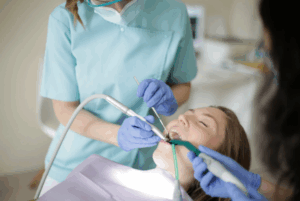
Greater palatine canal approach of MNB
High tuberosity approach:
This approach targets the maxillary nerve in the pterygopalatine fossa. It provides anesthesia to hemimaxialla and nearby tissues. First step is to identify and clean the highest point on mucobuccal fold to perform the block. Insert needle at a 45° angle and 3 cm. Slowly administer 1.8 ml of local anesthesia. This technique has a 95% success rate to achieve nerve block. If a needle is injured in the maxillary artery, then there is a risk of hemorrhage.
Complications linked to local anesthesia are:
Toxicity because of the administration of large amounts of anesthesia and allergic reactions
Complications linked to the technique:
Possible needle tract infection
Block of nerves in the nearby areas of the procedure
Nasal cavity penetration
Formation of retrobulbar hematoma
Numbness and persistent paresthesia
Sloughing of tissues and edema
LEARNING & CME
View All
Advanced
Cardiovascular
Life Support
Basic Life
Support

Pediatric
Advanced Life
Support

Neonatal
Resuscitation
Program

Annual Stroke
Center
Continuing
Education

Opioid and Pain
Management

National
Institutes of
Health Stroke
Scale

Basics of
Electrocardiography