






Laryngeal Mask Airways (LMA) is a medical device which maintains good airway flow and provides positive pressure ventilation.
Dr. Archie Brain, who recognized this device in 1981 as a safer and better option than endotracheal intubation.
The device is designed in form of elliptical mask attached to a tube that seals around the laryngeal inlet. This allows ventilation without tracheal tube insertion.
LMA is useful in various settings including the operation room, ED, and pre-hospital care due to its handling and speed. Success rate for LMA placement is nearly 100% in the operating room but it has lower rate in emergency settings.
The use of airway ventilation device reduces risk of gastric distention and aspiration, which is more crucial in non-fasted patients.
- Laryngeal Mask Airways
- Suction Device
- Lubricant
- Syringe for Cuff Inflation
- End-Tidal CO2 Detector
Patient Positioning:
Patient positioned in supine position with head in neutral alignment for LMA insertion.
Proper support to the head and neck should be given for optimal airway alignment and to avoid any risk during the procedure.
Step 1: Preparation of LMA:
Arrange LMA cuff, balloon, and inflation system at one place. Deflate cuff fully before insertion and prevent any kind of twisting.
Step 2: Insertion of LMA
Use index finger on nondominant hand to guide LMA into mouth then apply lubricant to mask for easier insertion.
Insert LMA along mouth midline, following palate curve. Then proceed steadily until resistance is felt, which indicates correct placement in oropharynx.
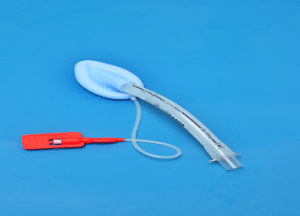
classic type of Laryngeal mask airway
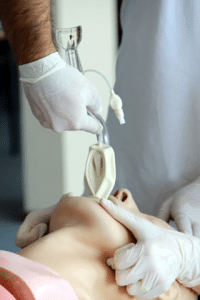
Insertion of Laryngeal mask airway
Step 3: Check Cuff Inflation and seal
Position LMA correctly, then inflate the cuff with appropriate air volume.
Confirm correct placement by checking chest spread and lung sounds.
Step 4: Final confirmation
Surgeons should double check for proper placement of device and monitor level of tidal volume and end-tidal CO2.
Incorrect handling of the device may lead to airway damage.
E.g., abrasions and lacerations
LMA insertion in the operation room can cause rare complications.
The complication rate was 0.15% in a large study, but it may be higher in emergencies cases.
Airway irritation or sympathetic nervous system stimulation during LMA trigger bronchospasm.
Some other noted complications as follows:
- Aspiration of gastric intake
- Pressure-induced lesions
- Mild sympathetic response
- Transient unilateral lingual nerve injury
LEARNING & CME
View All
Advanced
Cardiovascular
Life Support
Basic Life
Support
Pediatric
Advanced Life
Support

Neonatal
Resuscitation
Program

Annual Stroke
Center
Continuing
Education

Opioid and Pain
Management

National
Institutes of
Health Stroke
Scale

Basics of
Electrocardiography