






Laparotomy also known as celiotomy which is a surgical procedure that involves a large abdominal incision to access the peritoneal cavity. It is often used in medical situations but has specific contraindications and potential complications.
The interprofessional team plays a crucial role in managing patients undergoing this procedure. In the UK the laparotomies are common with 30,000 to 50,000 that are performed annually.
Preoperative preparation involves physical and emotional aspects that vary depending on the operation’s purpose. In cancer cases it involves nurse specialists for counseling is optimal. In emergencies, speaking with the patient’s next of kin or loved ones can help strengthen their support network.
Informed consent is crucial for preparing the patient and their relatives for the procedure. If the patient is unconscious or lacks capacity, Consent Form 4 can be completed in their best interests and requiring a documented mental capacity assessment and consultation with a close family member.
Physical preparation for ileostomy surgery varies depending on whether it’s an emergency or an elective procedure. Key considerations include hair removal, patient BMI, previous operative scars, hernias, and stoma site positioning.
In elective settings the weight loss may be requested to improve anesthetic suitability and reduce the distance the small bowel mesentery must traverse.
In a planned setting the smoking and diabetic control should be considered.
A nasogastric tube may be necessary in cases of obstruction or perforation.
Adequate fluid and electrolyte resuscitation, a urinary catheter, intravenous antibiotics, crossmatching units of blood products, and appropriate imaging such as CT abdomen and pelvis (CT AP) are also essential.
The surgical tools include a scalpel for making an initial incision in the abdominal wall, scissors for cutting tissues and sutures, retractor for exposing the abdominal cavity, suction devices for removing blood and fluids, surgical sponges, and laparotomy pads for blood absorption and maintaining a clear surgical field.
The surgical team uses needle holder and sutures for incision stitching and closing where anesthesia equipment for patient comfort, surgical gloves and gowns for sterility, and wound closure materials like staples or additional sutures for closure of incisions.
Supine Position:
When patient is lying flat on the operating table with arms tucked at the sides or placed on arm boards for access to the abdomen.
Midline/Median Approach:
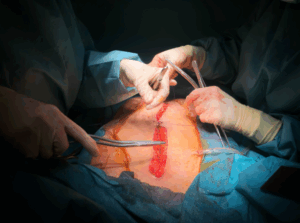
Abdominal incision
The midline approach is an incision used for laparotomy procedure that opens the abdomen to access abdominal and pelvic organs.
This vertical incision is located in the middle of the abdomen along the fibrous band called the linea alba. It is commonly used in abdominal surgeries including gastrointestinal surgeries and abdominal exploration.
Surgeons often create a contoured incision around the umbilicus using a Littlewood clamp to move it away from the midline. The incision is typically made with a scalpel but cauterization with a cutting cautery is an alternative for cutting the skin.
Coulative cautery is used to separate subcutaneous fat and superficial fascial layers that reaching the rectus sheath. The linea alba is an avascular plane that prevents muscle tissue encountering aponeuroses.
A paramedian laparotomy is an vertical incision made parallel to the midline that is typically on the left or right side of the lineal alba which is used to access abdominal organs.
It is often preferred over a midline laparotomy due to its reduced risk of incisional hernia and improved access to certain organs.
The horizontal cut across the abdomen is commonly used in abdominal surgeries like appendectomy, bowel resection, and hysterectomy, offering benefits like reduced risk of incisional hernia.
The approach is a surgical incision used for laparotomy procedure to open the abdomen for accessing pelvic and abdominal organs and commonly used for emergency C-sections and retrieving pathological specimens from other abdominal cavity parts.
The subcostal approach for laparotomy involves making an incision below the costal margin allowing access to the abdominal cavity for surgical procedures and forming a rooftop incision when left and right incisions meet at the midline.
The Complete Blood Count is a crucial tool for overall health and identifying potential health issues like anemia or infection.
The Blood Chemistry Panel includes tests such as electrolyte levels, kidney function tests, liver function tests, and glucose levels providing crucial information about the patient organ function and metabolic status.
Coagulation studies includes prothrombin time and ATP thromboplastin time that assess blood clotting ability and bleeding risk during and after surgery.
Urinalysis is a diagnostic procedure that examines the physical and chemical properties of urine, which identifies potential urinary tract infections or kidney issues.
Postoperative complications in the abdominal cavity can include infection, excessive bleeding, potential harm to adjacent organs, blood vessels, or nerves, adhesion formation, hematoma, postoperative pain, and potential complications like allergic reactions and breathing issues. Effective pain management is crucial for comfort and recovery, anesthesia can lead to allergic reactions and breathing issues.
Adhesion formation in the abdominal cavity can also lead to bowel obstruction.
LEARNING & CME
View All
Advanced
Cardiovascular
Life Support
Basic Life
Support
Pediatric
Advanced Life
Support

Neonatal
Resuscitation
Program

Annual Stroke
Center
Continuing
Education

Opioid and Pain
Management

National
Institutes of
Health Stroke
Scale

Basics of
Electrocardiography