






Intraosseous (IO) access is a medical procedure that involves accessing the marrow space of a bone to deliver fluids, medication, or blood products directly into the systemic circulation when intravenous access is difficult or impossible. Intraosseous access is not a new medical technique. It has been used for several decades, with evidence of its effectiveness dating back to World War II.
The procedure gained renewed attention in recent years due to advancements in technology and devices designed for IO access. Intraosseous access has become a vital tool in emergency medicine, allowing healthcare providers to deliver life-saving fluids, medications, and blood products quickly when intravenous access is difficult to establish. It has proven to be a crucial advancement in medical care, particularly in situations where time is of the essence, and conventional intravenous access may not be achievable.
- Patient Assessment: Evaluate the patient’s condition and the urgency of the situation to determine if IO access is necessary. Consider contraindications, allergies, and any other relevant medical history.
- Site Selection: Choose the appropriate anatomical site for IO access. Common sites include the proximal tibia (shin bone) and sternum (breastbone). The choice depends on the patient’s age, body habits, and provider familiarity.
- Skin Preparation: Ensure that the skin at the selected site is clean and free of infection. Use an antiseptic solution to sterilize the area.
- Pain Management: Administer local anesthesia to numb the area before inserting the IO needle or catheter to minimize discomfort and pain.
- IO Needle or Catheter: You will need an appropriate IO needle or catheter designed for safe and effective insertion into the bone. Common types include manual and automatic devices.
- IO Stabilization Device: Some IO needles come with integrated stabilization devices, but additional stabilization equipment may be necessary to prevent movement during the procedure.
- Sterile Gloves and Drapes: Use sterile gloves and drapes to maintain aseptic conditions during the procedure.
- Antiseptic Solution: An antiseptic solution, such as iodine or alcohol, is used for skin preparation before the insertion of the IO needle or catheter.
- Local Anesthetic: Local anesthetic (lidocaine, for example) for numbing the skin at the selected insertion site.
- Syringe: A syringe is used to aspirate and confirm correct placement of the IO needle by withdrawing bone marrow or observing blood return.
- Fluid Administration Set: You will need a fluid administration set to connect to the IO needle for infusing fluids and medications.
- Dressing and Securement Device: Once the IO access is established, use a sterile dressing and securement device to protect the site and prevent dislodgment.
- Extension Tubing: If necessary, extension tubing may be used to connect the IO catheter to the IV fluids or medications.
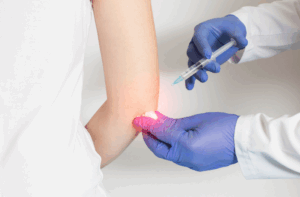
Step:1 – Patient Positioning:
- Place the patient in a comfortable position. For tibial access, it is often best to have the patient’s leg extended and supported.
- For sternal access, place the patient in a supine position.
Step:2 – Skin Preparation:
- Clean and disinfect the selected site (proximal tibia or sternum) using an antiseptic solution. Allow the area to dry.
Step:3 – Local Anesthesia:
- Administer local anesthesia at the insertion site to numb the skin and reduce patient discomfort.
Step:4 – Needle or Catheter Selection:
- Choose an appropriate IO needle or catheter based on the patient’s age, body habits, and your familiarity with the device.
Step:5 – Needle Insertion (Tibial Access):
- Hold the leg firmly but avoid excessive pressure.
- Locate the landmarks: the tibial tuberosity and the anterior aspect of the tibia, approximately 2 cm below the tibial tuberosity.
- Insert the IO needle at a 90-degree angle to the bone.
- Advance the needle with a twisting motion while applying gentle pressure until you feel a sudden decrease in resistance, indicating that the needle is in the marrow cavity.
Step:6 – Needle Insertion (Sternal Access):
- Identify the midpoint of the sternum.
- Insert the IO needle at a 90-degree angle to the bone, just below the sternal notch.
- Advance the needle with a twisting motion while applying gentle pressure until you feel a sudden decrease in resistance, indicating that the needle is in the marrow cavity.
Step:7 – Confirm Placement:
- Aspirate the syringe to check for bone marrow or observe blood return. This confirms that the needle is correctly placed in the marrow cavity.
Step:8 – Stabilization:
- Secure the needle or catheter in place using the built-in stabilizer or an external stabilization device to prevent movement.
Step:9 – Connect Fluid and Medication Administration:
- Attach a fluid administration set to the IO needle or catheter.
- Administer fluids, medications, or blood products as needed.
Step:10 – Securement:
- Apply a sterile dressing and securement device to protect the site and prevent dislodgment.
- Infection: Infection at the insertion site can occur, leading to cellulitis or osteomyelitis. Proper skin preparation and aseptic technique are essential to reduce this risk.
- Extravasation: If the IO needle or catheter is not properly secured, there is a risk of the needle becoming dislodged, leading to extravasation of fluids or medications into the surrounding tissues, potentially causing tissue damage.
- Compartment Syndrome: In rare cases, the infusion of fluids or medications into the bone marrow cavity can increase intraosseous pressure, potentially causing compartment syndrome, which can lead to tissue ischemia and nerve damage.
- Fracture or Dislocation: Inadvertent fracture or dislocation of the bone can occur during needle insertion, particularly if excessive force is applied.
- Hemorrhage: While IO access is associated with minimal bleeding, there is a small risk of hemorrhage, especially if the needle is incorrectly positioned or if the patient has a bleeding disorder.
- Needle Breakage: Rarely, the IO needle can break during insertion or removal, which poses a risk of retained foreign body and the potential for complications.
- Air Embolism: If air enters the bone marrow cavity, it can potentially lead to an air embolism, although this is extremely rare.
- Local Tissue Damage: The forceful insertion of the needle can cause local soft tissue damage and hematomas, particularly in patients with fragile or compromised tissues.
LEARNING & CME
View All
Advanced
Cardiovascular
Life Support
Basic Life
Support

Pediatric
Advanced Life
Support

Neonatal
Resuscitation
Program

Annual Stroke
Center
Continuing
Education

Opioid and Pain
Management

National
Institutes of
Health Stroke
Scale

Basics of
Electrocardiography