






Cephalic vein cutdown is a minimally invasive technique applied in surgery to identify the cephalic vein, situated in the lateral part of the forearm and arm. This technique is most helpful in cases where obtaining PVA is challenging due to poor visibility of the veins, collapsed veins, and patient-dependent factors including obesity and dehydration.
Equipments
Scalpel
Scissors
Hemostatic Forceps
Needles and Suture Material
Drape and Sterile Covers
Local Anesthetic
Syringe and Needle
Towel or Gauze
Venous Catheter
Ultrasound Machine (optional)
Sterile Gloves
Patient preparation
Pre-Procedure Assessment
Medical History: Ask the patient about allergies, current medications, previous surgeries, and personal history of bleeding problems.
Physical Examination: Carry out an assessment by paying special attention to the upper limbs with a view of identifying the nature and location of the cephalic vein.
Vital Signs: Record the patient’s blood pressure, pulse, temperature and rate of respiration.
Patient position
Supine Position: The patient is in the supine position on either examination bench or on an operating table.
Arm Positioning: This facilitates viewing of the cephalic vein at the wrist or distal forearm where the cutdown will be carried on the arm on the side of the patient facing the image, commonly the right arm.
Step 1: Identifying the Cephalic Vein: Locate the cephalic vein which lies just off the lateral part of the forearm or wrist. It may be more seen in persons with lesser subcutaneous tissue or those using tourniquet while taking a blood sample. Mark the vein’s location to guide your incision.
Step 2: Anesthesia: Local anesthetic agent should be injected around the area of cephalic vein. This step is important for the patient because it decreases the amount of pain during incision and procedure within the affected tissue.
Step 3: Making the Incision: With a scalpel, you’ll carefully open the skin and cut a straight line about 1-2 centimeters over the vein. The skin should be incised just enough to gain entrance to the venous space with undue pressure and trauma to the neighbouring tissues.
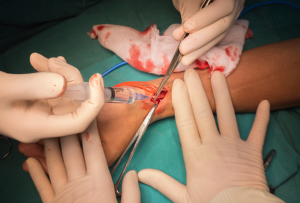
Cephalic vein cut down
Step 4: Dissecting to the Vein: Perform sharp dissection through the layer separating the subcutaneous tissue from the skin using scissors or making use of the blunt dissection tool in an effort not to remove nerves and Arterial structures. Make sure homeostasis by using gentle pressure on the wound site, or with the help of adopted hemostatic forceps.
Step 5: Exposing the Vein: When the cephalic vein is located the tissue should be moved out of the way to expose it better. Make sure not to traumatise the vein or the surrounding tissue. If there is more bleeding than minor oozing, you may apply hemostatic clamps.
Step 6: Cannulation: Kink the cephalic vein, and then turn the hub of the sterile IV catheter slightly to accommodate it, to allow the device to slide easily into the vein. Insert the catheter further into the vein until there is flashback of blood in the flashback chamber. Secure the catheter in place.
Step 7: Closure: Once the catheter is in position wash the site of the puncture with sterile saline. Suture or apply adhesive strips to counteract the wound effectively, again be sure to bring the edges of the skin together to heal well.
Step 8: Dressing: A sterile dressing should be done over the operated site for protective purpose against infections.
Step 9: Post-Procedure Care
Monitoring: Assess for immediate complication which may include bleeding, formation of hematoma or clinical indication of infection.
Monitor vital signs and ensure the IV line is patent and functioning correctly.
Patient Instructions: Instruct the patient about wound care and about what to look out for, in terms of signs of infection and when to return for follow up.
Step 1: Preparation:
The procedure will then be explained to the patient and consent to be obtained from the patient.
Position the patient comfortably, usually supine, preferably lying flat on the back with the affected arm outstretched.
Wash the hands and put on sterile gloves as necessary.
Step 2: Site Identification: Palpate the cephalic vein in the forearm or the wrist. Sometimes, an ultrasound can also be employed to examine the position, and caliber of the vein.
Skin Preparation: It’s important to wash the site with an antiseptic solution to minimize the possibility of an infection erupting.
Step 3: Local Anesthesia: Local anaesthetic can be given around the planned site of insertion to avoid pain during the process.
Cutdown: Cut the skin in an area near the vein which should not be more that 1-2 cm in length. Slowly and meticulously step-by-step make an incision through the subcutaneous tissue to isolate the cephalic vein.
Step 4: Accessing the Vein: Take the cephalic vein between the thumb and the index finger of the left hand using smallest possible hemostats or forceps.
Put a dilator or a catheter into the vein.
Step 5: Insertion of Catheter: If using the guidewire, then it is inserted into the vein and then shortly followed by the catheter. Confirm proper placement of the catheter, often by aspirating for blood or using ultrasound guidance.
Secure the Catheter: Fix the catheter position by stitching or bandaging the area to avoid shifting.
Put a sterile dressing over the site.
Step 6: Post-procedure Care: Closely observe the patient for any of the complications, particularly bleeding or infection.
Record the size and kind of catheter employed in the process, besides any adverse side effects.
- Complications
Infection: Like all interventions, the chance of having an infection from a site point or even the bloodstream (sepsis) is high at the point of incision.
Bleeding: There is often significant bleeding during or at the end of the procedure. This is especially the case if the nearby artery accidentally gets perforated.
Hematoma: They are edema and discomfort at the site of the cut down due to accumulation of blood in the extracellular space.
Nerve Injury: Since the nerves are located close to the cephalic vein there is every possibility of damaging them during the procedure and this may lead to pain, numbness and or weakness of the arm.
Thrombosis: Intravenous coagulation can form a thrombus (blood clot) within the vein which results to venous obstruction.
Laceration of the Vein: Improper technique can lead to laceration of the vein, which may necessitate further intervention.
Catheter-related Complications: These complications involving catheter misplacement, malfunction of the catheter, or migration of the catheter can develop.
LEARNING & CME
View All
Advanced
Cardiovascular
Life Support
Basic Life
Support

Pediatric
Advanced Life
Support

Neonatal
Resuscitation
Program

Annual Stroke
Center
Continuing
Education

Opioid and Pain
Management

National
Institutes of
Health Stroke
Scale

Basics of
Electrocardiography