






Cardiopulmonary resuscitation (CPR) is an emergency procedure designed to maintain some blood flow to the heart and brain in a person who is in cardiac arrest. It involves the combination of chest compressions and artificial ventilation to provide oxygen to the body’s vital organs when normal breathing and heart function have stopped.
The origins of CPR trace back to the early 18th century when various techniques were attempted, including blowing smoke into the rectum, or using bellows to stimulate breathing. However, the modern concept of CPR was developed in the mid-20th century.
- Kouwenhoven Method: Dr. James Elam and Dr. Peter Safar pioneered the “mouth-to-mouth” resuscitation technique in the 1950s.
- Cardiac Massage: Dr. Peter Safar and Dr. James Jude further developed CPR, combining chest compressions with artificial ventilation, known as the “cardiac massage” technique.
- CPR as We Know It: In 1960, the American Heart Association (AHA) endorsed the “mouth-to-mouth” method, which soon evolved into the combination of chest compressions and rescue breathing that we recognize as CPR today.
- AHA Guidelines: The AHA continues to update guidelines for CPR based on scientific research. They emphasize high-quality chest compressions and early defibrillation in cases of sudden cardiac arrest.
CPR is taught and practiced worldwide, saving countless lives each year. Its fundamental goal is to buy time for professional medical assistance to arrive and provide advanced care for those experiencing cardiac arrest.
- Protective Gear: Before initiating CPR, ensure you are wearing protective equipment such as gloves and a face shield to reduce the infection transmission and ensure your safety.
- Automated External Defibrillator (AED): If available, use an AED to analyze the patient’s heart rhythm and deliver electric shocks if needed. These devices are user-friendly and provide voice prompts for guidance.
- CPR Barrier Device: This is a one-way valve mask used to provide rescue breaths while preventing direct contact between the rescuer and the patient’s mouth.
- Safety: Ensure the safety of the rescuer and bystanders by assessing the scene for potential dangers. If the environment is unsafe, wait for professionals to arrive or ensure the area is secure before beginning CPR.
- Position on a Firm Surface: Lay the patient on a firm, flat surface to provide effective chest compressions. For adults and children, this is typically the ground or a hard floor. For infants, a table or countertop may be suitable.
- Supine Position: The patient should be in a supine position (lying on their back) for CPR. This position allows for easier access to the chest for chest compressions and the application of an AED.
- Clear the Chest: Ensure the patient’s chest is clear of any obstacles, clothing, or items that may interfere with chest compressions.
- Adequate Exposure: For effective chest compressions, the patient’s chest should be exposed. Remove any clothing that covers the chest if necessary.
- Correct Hand Placement: For adult CPR, position the heel of one hand on the center of the chest, just below the nipple line. Place the other hand on top of the first hand, interlocking the fingers. For children and infants, use one hand or two fingers, respectively.
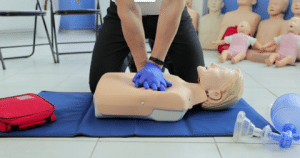
- AED Attachment: If an AED is available, attach the electrode pads to the patient’s chest as per the manufacturer’s instructions. These pads typically have visual aids for proper placement.
Step-1: Assess the Scene
- Ensure the safety of yourself, the victim, and any bystanders.
- If the scene is safe, approach the victim and check for responsiveness by tapping and shouting, “Are you okay?”
Step-2: Call for Help
- If the victim is unresponsive, immediately call emergency services or ask a bystander to do so.
Step-3: Check for Normal Breathing
- Place your ear near the victim’s mouth and nose to listen and feel normal breathing (not gasping).
Step-4: Chest Compressions
- If the victim is not breathing normally or not at all, start chest compressions.
- Kneel down beside the victim, place the heel of one hand on the center of their chest, just below the nipple line.
- Place the other hand on top of firsthand by interlocking your fingers.
- Keep your arms straight, your shoulders directly over hands, and your body weight centered over the victim’s chest.
- Compress the chest at 2 inches deep at a rate of about 100 to120 compressions per minute. Allow chest to fully recoil between compressions.
- Continue compressions until professional help arrives or the victim starts breathing normally.
Step-5: Provide Rescue Breaths
- After the 30 compressions (in a 30:2 compression-to-ventilation ratio), give two rescue breaths.
- Ensure an open airway by tilting the victim’s head back slightly and lifting chin up.
- Pinch the victim’s nose shut and place your mouth over theirs, creating a seal.
- Give a breath that lasts about one second and makes the chest rise visibly.
- Repeat this process for each set of 30 compressions.
Step-6: Continue CPR
- Alternate cycles of 30 chest compressions and two rescue breaths.
- Continue CPR until the victim starts breathing, emergency personnel take over, or you are physically unable to continue.
Step-7: Use an AED
- If an automated defibrillator is available, follow its voice prompts. Attach the AED pads to the victim’s chest as instructed, and let the AED analyze the heart rhythm. If advised, deliver a shock, and continue CPR.
Step-8: Provide Sustained CPR
- If no AED is available, continue CPR without interruption until professional help arrives or the victim shows signs of life.
- Rib Fractures: Chest compressions can sometimes lead to rib fractures or damage to the sternum. This is more likely in older individuals with fragile bones.
- Lung and Chest Injuries: Forceful chest compressions may cause lung injuries like pneumothorax (collapsed lung) or hemothorax (blood in the chest cavity). It can also lead to chest wall injuries.
- Abdominal Injuries: The pressure from chest compressions can sometimes lead to abdominal injuries, such as liver or spleen damage.
- Infections: Performing mouth-to-mouth ventilation can expose the rescuer to potential infections, although the risk is low.
- Aspiration: During rescue breaths, there is a risk of stomach contents entering the victim’s airway, leading to aspiration pneumonia.
- Misplaced Ventilations: In some cases, the rescuer may unintentionally ventilate into the stomach rather than the lungs.
- Cardiac Injuries: Chest compressions can cause cardiac injuries, particularly if the person’s underlying condition includes heart disease.
- Fractures: In rare cases, CPR may lead to fractures in the upper extremities of the victim due to pressure exerted by the rescuer.
- Dislocations: Joint dislocations, particularly in the shoulders, can occur from the force applied during chest compressions.
LEARNING & CME
View All
Advanced
Cardiovascular
Life Support
Basic Life
Support
Pediatric
Advanced Life
Support

Neonatal
Resuscitation
Program

Annual Stroke
Center
Continuing
Education

Opioid and Pain
Management

National
Institutes of
Health Stroke
Scale

Basics of
Electrocardiography